
The transition toward the Autonomous Enterprise represents the core strategic imperative for modern IT and enterprise architecture. In its global series „Architecting the Autonomous Enterprise – A Webinar Series for Architects, By Architects“, SAP demonstrated across 12 deep-dive sessions how SAP BTP, Joule Studio, SAP Knowledge Graph, Clean Core, and AI Governance integrate in enterprise reality.
This dossier provides enterprise architects, solution architects, and technology leaders with a curated synthesis of the complete series — featuring direct replay links, slide deck references, and detailed architectural summaries and key takeaways for each episode (expandable on click).
„An autonomous enterprise does not emerge from isolated chatbots, but from the tight coupling of corporate semantics, deterministic process guardrails, and agentic orchestration upon a Clean Core foundation."
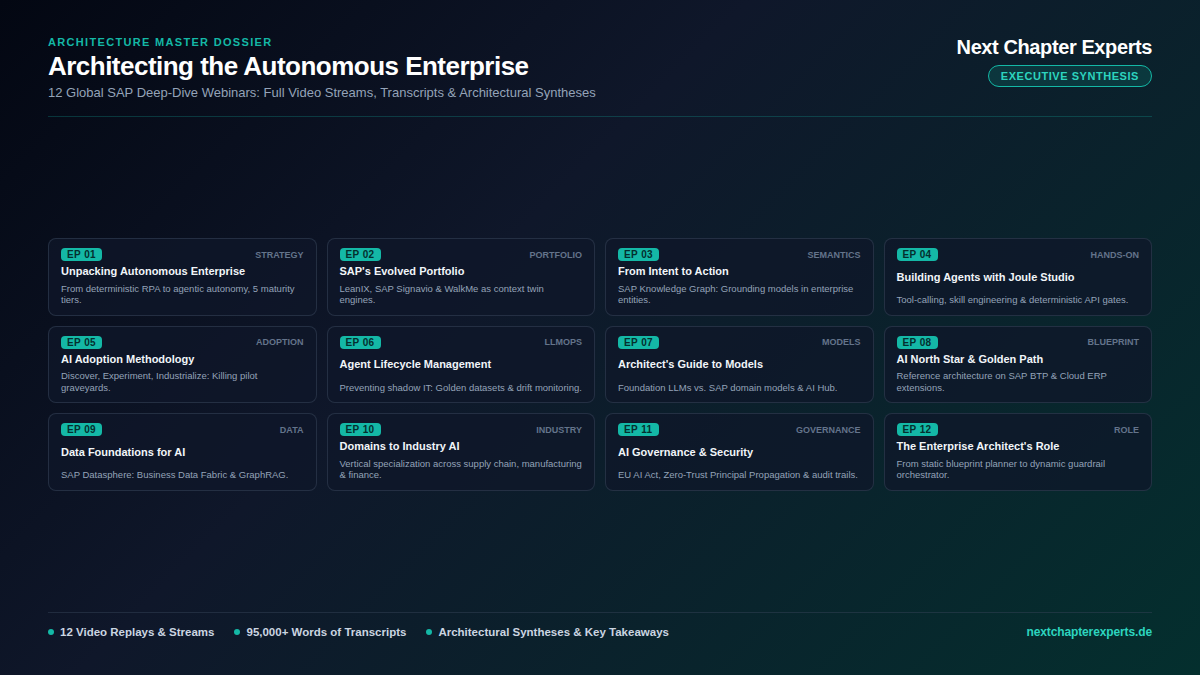
The 12 Episodes with Video Replays & Detailed Summaries
Episode 01: Unpacking Autonomous Enterprise for Enterprise Architects
Core Focus: Moving from RPA to agentic workflows, 5 autonomy tiers, Joule & BTP synergy.
Watch Official Video Replay
Expand Architectural Assessment & Key Takeaways for Episode 01
Key Takeaways
- Shift from deterministic process automation (RPA, static workflows) to agentic, goal-driven autonomy.
- Enterprise Architects must transition from designing rigid blueprints to orchestrating dynamic, adaptive AI systems.
- Business context is the missing link: generic foundation models lacking deep SAP enterprise context fail in real-world workflows.
- Clean Core principles are essential to guarantee agents interact through standard, upgrade-safe APIs without custom ABAP entanglements.
1. Vision of the Autonomous Enterprise
The inaugural session defines the Autonomous Enterprise not as superficial hype or simple chatbot overlays, but as a foundational evolution from rigid ERP transactions to goal-driven, self-governing business processes. Where classical automation relies on static if-then rules, autonomous systems operate against outcomes, anticipate bottlenecks, and execute bounded decisions within governed guardrails.
2. The Evolving Role of the Enterprise Architect
• From Gatekeeper to Enabler: Architects define guardrails within which autonomous agents safely operate. • Context Architecture: Data must not remain siloed. Architects must deliver semantic data models and enterprise context to generative models. • Clean Core as Prerequisite: A modification-free core (S/4HANA Clean Core) with standardized OData/REST APIs is required for dependable agentic ERP interactions.
3. Core Architectural Pillars
- Intelligence Layer: SAP Joule, Foundation Models, Generative AI Hub.
- Semantic Layer: SAP Knowledge Graph, Datasphere Semantics.
- Process & Governance Layer: SAP Signavio, LeanIX, AI Agent Hub.
- Operations & Integration Layer: SAP BTP Integration Suite & Extension Suite.
Practical Recommendations for SAP Architects
- BTP Cockpit Alignment: Verify that essential BTP services (Generative AI Hub, AI Core, HANA Cloud) are securely connected to the Cloud ERP.
- Clean Core Governance: Strictly enforce standardized APIs and event-driven architectures instead of core ERP code modifications.
- Observability & Auditability: Establish the SAP AI Agent Hub for complete audit logging of all autonomous agent interactions.
Episode 02: What SAP's Evolved Portfolio Means for Architects
Core Focus: Positioning LeanIX, SAP Signavio, and WalkMe within modern AI architecture.
Watch Official Video Replay
Expand Architectural Assessment & Key Takeaways for Episode 02
Key Takeaways
- Transformation of the SAP portfolio from monolithic ERP engines to a modular, AI-enabled business suite.
- SAP BTP serves as the technological backbone for AI extensions, orchestration, and seamless integration.
- Integration of LeanIX (architecture visibility) and Signavio (process intelligence) forms the twin engine for AI.
- Shift away from isolated point solutions toward embedded Business AI across all core business processes.
1. Portfolio Evolution & Building Blocks
This session examines how SAP strategic acquisitions (LeanIX for Enterprise Architecture Management, SAP Signavio for Process Mining, and WalkMe for Digital Adoption) interlock to provide the architectural foundation for contextual AI in enterprise processes.
2. LeanIX & Signavio as AI Context Engines
• LeanIX provides the architectural map: What applications, interfaces, and data objects exist? • Signavio provides process reality: How are processes actually executed, where do bottlenecks and variations occur? • AI agents leverage this rich metadata as semantic context to dynamically optimize business execution.
3. The Role of SAP BTP
SAP BTP delivers the centralized integration, data, and AI foundation. It decouples custom agentic extensions from the ERP core, safeguarding upgrade readiness in line with Clean Core standards.
Practical Recommendations for SAP Architects
- Architecture & Process Inventory: Connect LeanIX fact sheets with Signavio process models to build an accessible enterprise knowledge base for AI.
- Extension Strategy: Mandate SAP BTP as the exclusive execution environment for bespoke agentic orchestration.
- Comprehensive Adoption Management: Deploy WalkMe for contextual user guidance during agent-assisted process changes.
Episode 03: Architecting From Intent to Action
Core Focus: Joule work patterns, intent recognition, knowledge grounding via SAP Knowledge Graph.
Watch Official Video Replay
Expand Architectural Assessment & Key Takeaways for Episode 03
Key Takeaways
- "The future of AI is not determined by the intelligence of the model. It is determined by the quality of the business context surrounding it."
- The SAP Knowledge Graph connects unstructured user intents with structured ERP business entities.
- "AI inherits the task. Humans provide the judgment." – Context managed as a primary enterprise asset.
- Elimination of hallucinations through deterministic grounding in real-time ERP master data and business objects.
1. The Intent-to-Action Paradigm
Transitioning from conversational assistants to actionable agents requires precise intent recognition. The system must decipher user goals, translate them into domain objects, and execute validated API calls in the backend ERP.
2. SAP Knowledge Graph as the Semantic Backbone
The SAP Knowledge Graph elevates flat relational schemas into an interconnected enterprise ontology, linking customers, purchase orders, suppliers, and contractual policies so models grasp full enterprise context.
3. Grounding & Hallucination Prevention
Grounding model responses against the Knowledge Graph ensures that generated actions are rooted in validated business data and conform to ERP transaction integrity.
Practical Recommendations for SAP Architects
- Context Before Models: Prioritize clean master data and semantic relationship modeling before pursuing bespoke model fine-tuning.
- Intent Catalog Implementation: Standardize recognized business intents and map them deterministically to BTP service endpoints.
- Human-in-the-Loop Safeguards: Mandate explicit human confirmation gates before executing high-impact transactional operations.
Episode 04: Building Agents with Joule Studio
Core Focus: Hands-on playbook: Building custom SAP agents with Joule Studio and tool-calling.
Watch Official Video Replay
Expand Architectural Assessment & Key Takeaways for Episode 04
Key Takeaways
- Bridging the Enterprise Readiness Gap: Prototypes take minutes; production-grade agents demand enterprise guardrails.
- SAP Joule Studio serves as the AI-native development environment for skills, triggers, and orchestration.
- Intent-Driven Development paired with standardized API connectors (OpenAPI, SAP Destination Service).
- Security, identity propagation, and granular permission checks natively embedded in the runtime framework.
1. Joule Studio as the Agent Workbench
Joule Studio offers architects and engineers a cohesive environment to define agent capabilities (skills), configure robust system instructions, and connect directly to backend APIs.
2. Tool-Calling & API Connectivity
Agents interface with enterprise systems through deterministic tool definitions. Joule Studio manages authentication via SAP BTP Destinations and safely passes user credentials via Principal Propagation.
3. Guardrails & Validation Cycles
Built-in schema validation ensures responses and function calls adhere strictly to predefined data contracts before execution.
Practical Recommendations for SAP Architects
- Leverage Standard Connectors: Favor prebuilt SAP integration artifacts over custom bespoke interface wrappers.
- Granular Least Privilege: Restrict each agent skill strictly to the minimal API permissions necessary for its intended scope.
- Prompt Version Control: Manage system prompts, schemas, and skill definitions under regular Git version control and CI/CD pipelines.
Episode 05: SAP's AI Adoption Methodology
Core Focus: Phased adoption framework: Discover, Experiment, Industrialize with enterprise gates.
Watch Official Video Replay
Expand Architectural Assessment & Key Takeaways for Episode 05
Key Takeaways
- Structured 3-tier maturity framework: Base AI → Premium AI → Custom AI.
- Systematic use-case prioritization based on business impact, feasibility, and data readiness.
- SAP Joule as the unified single point of entry across all SAP business applications.
- Preventing fragmented pilot graveyards through standardized reference architecture patterns.
1. The 3-Tier AI Maturity Framework
SAP differentiates between turnkey embedded intelligence (Base AI), enhanced contextual scenarios (Premium AI), and bespoke enterprise agents (Custom AI), enabling structured architectural roadmaps.
2. Use-Case Valuation & Scoring
Not every technically feasible use case justifies production investment. A structured scoring matrix evaluates initiatives by measurable ROI, data maturity, and risk exposure.
3. Industrialization & Scale
Transitioning successful proofs of concept into scalable production services requires standard BTP deployment pipelines, defined SLAs, and operational support tiers.
Practical Recommendations for SAP Architects
- Start with Base Scenarios: Deploy turnkey standard scenarios (Base AI) early to deliver immediate business value with low implementation overhead.
- Business Sponsorship: Require executive line-of-business co-ownership before committing engineering resources to custom AI builds.
- Architecture Governance Gates: Establish mandatory architecture reviews before advancing prototypes to production status.
Episode 06: AI Agent Lifecycle Management at Scale
Core Focus: Enterprise LLMOps: Golden datasets, regression test suites, and model drift detection.
Watch Official Video Replay
Expand Architectural Assessment & Key Takeaways for Episode 06
Key Takeaways
- Mitigating AI Shadow IT: Preventing uncontrolled proliferation of unmonitored copilots, agents, and API keys.
- SAP AI Agent Hub serves as the centralized control and observability plane for autonomous agents.
- Mapping agents directly to enterprise architecture models (capabilities, systems, and data assets).
- End-to-end lifecycle governance: Discovery → Governance → Observation → Optimization.
1. The Challenge of Enterprise Scale
As dozens of autonomous agents operate concurrently, organizations face risks regarding runaway token consumption, response latency drift, and permission escalation.
2. Observability & Real-Time Monitoring
Continuous tracking of token utilization, latency distributions, error rates, and user feedback through a unified dashboard is essential for operational stability.
3. Automated Regression Testing via Golden Datasets
Because cloud-hosted models undergo periodic internal updates, automated evaluation against static, curated test sets is required to detect regressions before they disrupt operations.
Practical Recommendations for SAP Architects
- Centralized Agent Inventory: Catalog every deployed enterprise agent within the SAP AI Agent Hub and LeanIX.
- Automated Drift Detection: Schedule weekly synthetic regression suites to verify schema compliance and output determinism.
- Cost & Quota Governance: Enforce budget caps and token quotas per department and agent service instance.
Episode 07: An Architect's Guide to the SAP Family of Models
Core Focus: Decision matrices: Foundation models vs. fine-tuning vs. SAP domain-specific models.
Watch Official Video Replay
Expand Architectural Assessment & Key Takeaways for Episode 07
Key Takeaways
- General foundation models (GPT-4, Claude, Gemini) versus SAP domain-specific architectures.
- SAP Foundation Models are trained on enterprise metadata, ABAP semantics, CDS views, and transaction graphs.
- Multi-model strategy: Aligning the optimal model with task requirements for cost, latency, and accuracy optimization.
- SAP Generative AI Hub provides model-agnostic orchestration and centralized token governance.
1. The Enterprise Model Spectrum
Enterprises must balance large general-purpose frontier models against domain-tuned architectures that often deliver higher precision at lower latency and cost for SAP-specific tasks.
2. SAP Domain-Tuned Models
SAP proprietary models are engineered around ERP schema dynamics, CDS hierarchies, and business logic patterns, excelling at deterministic enterprise tasks.
3. Decoupling via Generative AI Hub
Architects connect enterprise applications to the Generative AI Hub rather than binding directly to a single model provider, enabling zero-code provider switching as market dynamics shift.
Practical Recommendations for SAP Architects
- Fit-for-Purpose Model Selection: Use smaller specialized models for classification and routing; reserve frontier models for complex multi-step reasoning.
- Prevent Provider Lock-in: Interact with AI models strictly through the Generative AI Hub abstraction layer.
- Continuous Benchmarking: Regularly evaluate latency, token efficiency, and output quality across competing model endpoints.
Episode 08: AI North Star Architecture & Golden Path
Core Focus: Reference architecture on SAP BTP: Integration Suite, AI Core, and Cloud ERP extensions.
Watch Official Video Replay
Expand Architectural Assessment & Key Takeaways for Episode 08
Key Takeaways
- The AI North Star Architecture as the comprehensive target blueprint for the autonomous enterprise.
- The AI Golden Path: Curated design patterns and starter kits to accelerate delivery without compromising standards.
- Bridging integration barriers between SAP Cloud ERP, SAP BTP, and non-SAP enterprise estates.
- Distinct separation of concerns across data fabrics, orchestration runtimes, and user experiences.
1. The North Star Reference Architecture
This blueprint formalizes the unified coexistence of SAP Cloud ERP, BTP platform services, and external cloud infrastructure, detailing standardized interface patterns and communication protocols.
2. The Golden Path for Development Teams
Pre-validated architecture templates accelerate project timelines while ensuring Clean Core compliance and security standards are met from day one.
3. Hybrid & Multi-Cloud Coexistence
How to integrate external hyperscaler AI services (AWS Bedrock, Azure OpenAI, GCP Vertex) within a centrally governed SAP architecture.
Practical Recommendations for SAP Architects
- Standardize on Proven Blueprints: Mandate approved Golden Path reference patterns for all new AI engineering initiatives.
- Architecture Review Board: Institute regular review cadences to evaluate deviations from the North Star blueprint.
- BTP as the Enterprise Hub: Channel external data and application integrations exclusively through SAP Integration Suite.
Episode 09: Data Foundations for an Autonomous Enterprise
Core Focus: SAP Datasphere, data fabric principles, semantic layers, and GraphRAG in ERP.
Watch Official Video Replay
Expand Architectural Assessment & Key Takeaways for Episode 09
Key Takeaways
- "No AI without data, no autonomous enterprise without business semantics."
- SAP Datasphere as the centerpiece of the modern Business Data Fabric.
- Preserving semantic integrity when surfacing ERP data to vector stores, lakehouses, and LLM prompts.
- Zero-Data-Duplication: Federated data architectures over brittle, monolithic data synchronization pipelines.
1. The Business Data Fabric
Autonomous systems demand trustworthy data. The data fabric connects transactional ERP systems with analytical platforms without destroying core business semantics (currencies, units, hierarchies).
2. Federation Over Replication
Rather than copying massive transactional volumes into centralized data dumps, Datasphere enables real-time federated querying while preserving underlying security contexts.
3. Semantic Grounding for GraphRAG
Standard vector RAG often fails on tabular business records. Structuring enterprise data through semantic layers ensures accurate reasoning in retrieval pipelines.
Practical Recommendations for SAP Architects
- Preserve Business Semantics: Structure all AI data consumption through formal semantic models (e.g., Datasphere Analytic Models).
- Inherit Security Contexts: Ensure backend row-level authorizations propagate through to generative retrieval workflows.
- Prioritize Master Data Hygiene: Treat core data quality as the primary bottleneck for autonomous agent reliability.
Episode 10: From Autonomous Domains to Industry AI
Core Focus: Domain use cases: Autonomous supply chain, predictive finance, and procurement.
Watch Official Video Replay
Expand Architectural Assessment & Key Takeaways for Episode 10
Key Takeaways
- Two dimensions of enterprise autonomy: Horizontal functions (Finance, HR, SCM) vs. vertical industry use cases.
- Specialized industry agents for manufacturing, retail, utilities, and automotive supply chains.
- A unified platform foundation (BTP + Joule) scaling across diverse operating domains.
- End-to-end process visibility dismantling legacy functional silos.
1. Horizontal vs. Vertical Autonomy
While cross-functional tasks (such as invoice validation or travel requests) remain standard, industry-specific processes (such as batch tracking or energy trading) require deeply tailored logic.
2. Production Case Studies in Core Industries
Examining operational implementations: Dynamic inventory reallocation during supply disruptions in manufacturing and predictive maintenance in logistics.
3. Capitalizing on Platform Synergies
Even highly specialized industry agents reuse shared platform primitives (Knowledge Graph, AI Core, Identity Services).
Practical Recommendations for SAP Architects
- Adopt a Dual-Track Strategy: Deliver quick wins in horizontal operations while concurrently architecting differentiating industry agents.
- Engage Domain Specialists: Partner directly with operational experts to co-design agentic task workflows and decision trees.
- Drive Component Reuse: Package domain capabilities as modular BTP artifacts reusable across subsidiary business units.
Episode 11: AI Governance and Security
Core Focus: GDPR, EU AI Act, Principal Propagation, role-based access control, and audit trails.
Watch Official Video Replay
Expand Architectural Assessment & Key Takeaways for Episode 11
Key Takeaways
- Full compliance with emerging regulatory frameworks (EU AI Act, ISO 42001, global privacy mandates).
- The Mosaic Governance model for agents: Delegated authority, auditability, and legal accountability.
- Security guardrails: Input sanitation, output filtering, and defensive architectures against prompt injection.
- IAM for Autonomous Agents: Establishing verifiable digital identities under the principle of least privilege.
1. Regulatory Mandates & Compliance
The EU AI Act and global data regulations demand strict transparency, risk classification, and auditability for automated decision-making systems.
2. Security Architecture & Threat Defense
Defending against prompt injections, data leakage, and unauthorized function invocation through multi-tier inspection filters in SAP Generative AI Hub.
3. Immutable Audit Trails
Every autonomous decision and resulting transactional API invocation must be recorded within a tamper-proof audit log for forensic accountability.
Practical Recommendations for SAP Architects
- Zero Trust for Agents: Never deploy agents with blanket administrative credentials; propagate user identities via Principal Propagation.
- Pre-Deployment Compliance Audits: Evaluate every new agent release against formal EU AI Act criteria before production enablement.
- Immutable Log Archival: Store compliance audit logs in tamper-evident storage separate from operational application traces.
Episode 12: Role of an Enterprise Architect in driving Autonomous Enterprise
Core Focus: The evolving architect: Transitioning from systems planner to guardrail orchestrator.
Watch Official Video Replay
Expand Architectural Assessment & Key Takeaways for Episode 12
Key Takeaways
- Three core imperatives for enterprise architects in the generative era.
- Imperative 1: Make architecture data agent-ready (LeanIX and Signavio as machine-readable context).
- Imperative 2: Architect for business outcomes (Focus on measurable value over technology fascination).
- Imperative 3: Own the guardrails (Active leadership across governance, risk, and ethical boundaries).
- Evolution from traditional systems planner to strategic co-pilot of business leadership.
1. The Architectural Paradigm Shift
Enterprise architects no longer draft rigid multi-year roadmaps. They design dynamic ecosystems capable of bounded autonomous optimization.
2. Architecture as Dynamic Context
LeanIX architectural repositories and Signavio process maps no longer exist purely for human review; they are queried directly by agents as runtime context.
3. Expanded Strategic Mandate
Architects serve as the crucial linchpin connecting corporate strategy, security, compliance, and agile development teams.
Practical Recommendations for SAP Architects
- Curate Architecture Metadata: Maintain LeanIX and Signavio repositories as living, machine-readable knowledge bases.
- Agile Guardrails: Replace manual gating with automated policy evaluations directly inside CI/CD deployment pipelines.
- Continuous Upskilling: Educate architecture teams in probabilistic systems design, enterprise ontologies, and LLMOps.
The 5 Pillars of Autonomous Enterprise Architecture
Across 12 hours of presentations and over 95,000 spoken words, five foundational architectural principles stand out:
1. Clean Core as the Non-Negotiable Prerequisite
Autonomous agents can only execute dependable transactions if the underlying ERP core remains pristine and standard. Legacy ABAP modifications fracture semantic interfaces. Custom extensions belong strictly on SAP BTP.
2. Semantic Context Outperforms Pure Vector Search
Language models hallucinate when fed disconnected document fragments. SAP grounds intelligence in the SAP Knowledge Graph, capturing business entities, contracts, and hierarchies as an interconnected relational web.
3. Deterministic Shell Around Probabilistic Cores
AI agents generate probabilistic outputs. Critical enterprise transactions must never be executed unchecked. Strict schema validation, state machines with retry ceilings, and human-in-the-loop escalation gates are essential.
4. Zero Trust & Principal Propagation
AI agents must never possess unrestricted service-user privileges. The end user's authenticated identity must be securely forwarded through OAuth / SAML principal propagation down to the backend transaction.
5. Automated LLMOps & Continuous Regression Testing
Underlying cloud models change without notice. Automated evaluation against curated golden datasets is required to catch regressions before they impact business operations.
Executive Takeaway for Practice & Project Teams
The webinar series makes one reality clear: The era of disconnected AI experiments is over. Building resilient autonomous enterprise systems requires uniting enterprise architecture, integration expertise, and AI engineering.
For architecture evaluations, SAP BTP prototyping, or executive briefings, feel free to reach out.
Legal Notice & Disclaimer
The links, references, and summaries in this dossier are provided exclusively for informational and professional analysis purposes.
- Intellectual Property: All rights to the original webinars, recordings, and slide decks belong to SAP SE.
- Independence: This publication is an independent analysis by Peter Alexander (Next Chapter Experts) and does not represent an official position or endorsement by SAP SE.
- EU AI Act Notice: Parts of this document were prepared with the assistance of AI systems and editorially reviewed.