The following diagrams summarise how the roles from this blog series — the Intent Architect, Governance Officer, Agent Supervisor, Semantic Engineer, Admins, and Developers — interact in one coherent picture. Diagram 1 shows the layer model; Diagram 2 condenses the same conceptual framework into a concrete, time-based process flow.
Diagram 1: The Layer Model
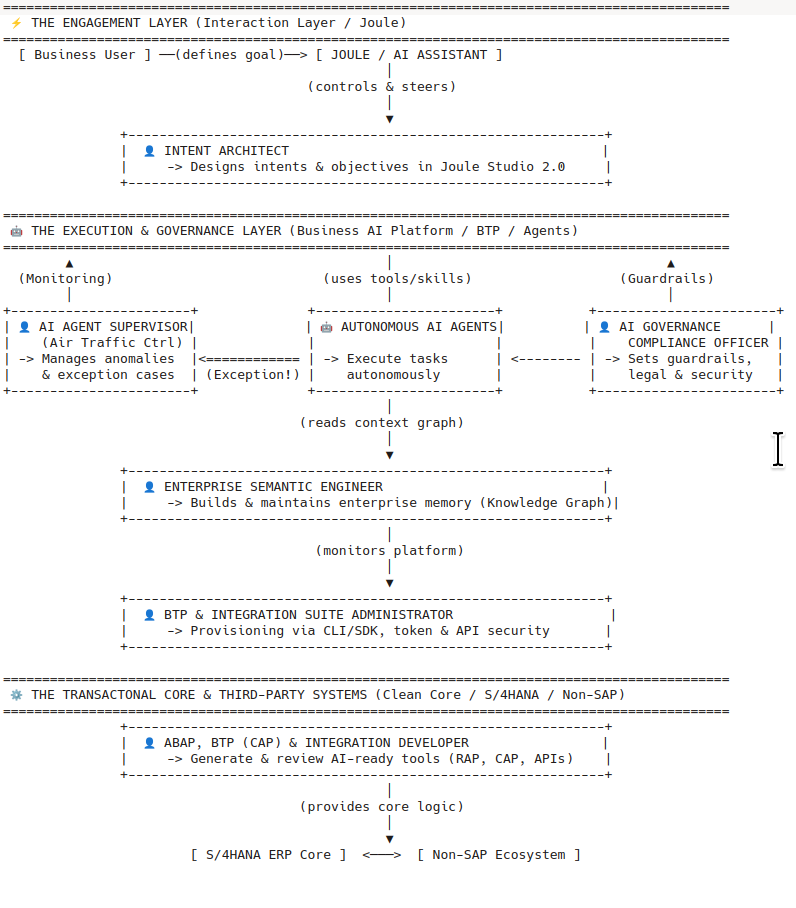
Detailed Explanation — Diagram 1: The Layer Model (Engagement, Governance & Execution Layer)
This structural diagram shows the hierarchical distribution of competencies within the Autonomous Enterprise. It illustrates that the Business AI Platform is not a single tool but a finely tuned ecosystem in which every role secures a specific layer:
-
The Engagement Layer: At the top sits the business user. They communicate through Joule using free-text natural language. The bridge between human intent and AI logic is built by the Intent Architect. They no longer programme how data flows; instead, they define in Joule Studio 2.0 the "target pattern" (intent) that the AI is to achieve.
-
The Execution & Governance Layer: This is the actual engine of autonomy. Here AI agents act independently. However, they are surrounded by two human control instances:
- The AI Governance & Compliance Officer builds legally compliant, data-privacy-safe guardrails around them.
- The AI Agent Supervisor monitors the system as the operational air traffic controller via dashboards, stepping in whenever the AI raises an exception.
-
The Semantic Data Layer: Beneath the agents lies the company's digital memory — the SAP Knowledge Graph. The Enterprise Semantic Engineer maintains this network so that AI agents can correctly interpret the company's business relationships.
-
The Infrastructure Layer: The BTP & Integration Suite Administrator ensures that the platform (e.g. SAP AI Core and API Management) runs in a performant, secure, and Cloud SDK-scalable manner.
-
The Transactional ERP Core (Clean Core): At the very bottom lies the uncompromising foundation — SAP S/4HANA. Here ABAP and BTP developers, aided by AI-assisted engineering, ensure that clean RAP objects and CAP services are available as standardised tools that AI agents may invoke in the core.
Diagram 2: The Process Flow Diagram
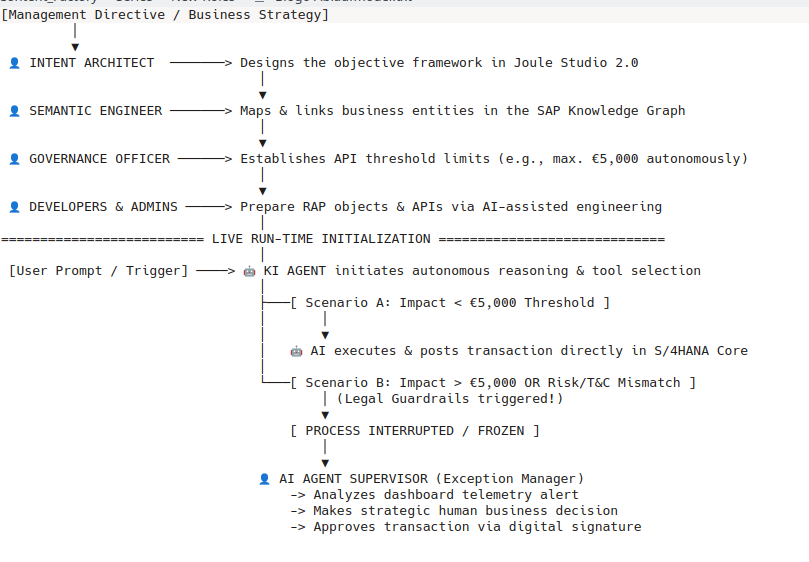
Detailed Explanation — Diagram 2: The Process Flow Diagram (The Practical Example in Motion)
This flow diagram breaks the theoretical architecture down into a concrete, time-based process in practice. It illustrates chronologically how a management decision is implemented in the system in a fully automated and legally sound manner:
-
The preparation (design-time): Management issues a strategic directive (e.g. prioritising semiconductors via European supply routes). Before any system becomes active, the tech roles work hand in hand:
- The Intent Architect defines the strategic goal in Joule Studio.
- The Semantic Engineer links the relevant material and supplier nodes in the Knowledge Graph.
- The Governance Officer sets a hard limit in the system (e.g. maximum autonomous budget approval of €5,000).
- Developers and Admins prepare the APIs and core objects.
-
Live execution (run-time): A user triggers the process via a prompt. The AI agent starts its logical reasoning and autonomously selects the appropriate tools. The path then splits based on the stored rules:
- Path A (standard case): If the cost of the route change is below €5,000, the agent automatically re-books the document in the S/4HANA core. The process runs in seconds with no human intervention.
- Path B (exception / emergency brake): If costs exceed the limit, or if the supplier's T&Cs change unexpectedly, the legal guardrails are triggered. The agent's autonomy is immediately blocked and the process is frozen.
-
Human decision (exception handling): The case is routed as an alert to the AI Agent Supervisor's dashboard. They assess the risk from a business perspective, manually override the system block, and approve the document with their digital signature in a legally sound manner. The audit trail for external auditors remains seamlessly complete.